
What It Really Takes: Lessons from Managing Large, Complex EU Research Consortia
On 7th May 2026, we ran a 25-minute session at the EARMA Annual Conference in Utrecht under the title What It Really Takes: Lessons from Managing Large, Complex EU Research Consortia. The session was co-presented with Katrin Reschwamm (ETH Zurich), and the room was full with more than 100 attendees, mostly research managers and administrators with some skin in the consortium-management game.
This post does two things. First, it walks through what we presented: how we tried to define "large," how we built the evidence base, what 80,540 CORDIS-listed projects show, what three senior practitioners said in long interviews, and what we think it all adds up to. Second, at the end, it shares what the audience told us through three live Slido polls, including the moment when 95% of the room placed partner count above budget as the defining feature of a 'large' project.
The CORDIS analysis and underlying data are queryable at orientos.com/cordis-db-analysis.

Why This Session, and Why Now
Large EU consortia often get treated as a special case. They come with more governance layers, dedicated PM work packages, specialized training, and separate working groups. The implicit framing is that managing a 40-partner project requires a different toolkit from managing a 5-partner one. We started this work because our own experience suggested otherwise. Our hunch, drawn from a couple of decades of hands-on practice between us, was that large projects are not categorically different from smaller ones in project-management terms. They are simply more of everything: more partners, more reporting cycles, more meetings, and more accumulated risk. Same job, multiplied.
We aimed to test that hunch against three independent sources: the CORDIS data on 80,000+ signed grants across FP7, Horizon 2020, and Horizon Europe; in-depth interviews with three practitioners who have collectively managed projects with up to 70 partners and €100M; and a small experiment with five frontier AI models, asking each what it considered the top five challenges of managing a large consortium. If those three sources agreed, that would tell us something. If they disagreed, that would also tell us something.
What "Large" Actually Means
The first finding came from the audience itself, before we showed any data. We asked the room to pick the top two factors that make a project "large." The funder framing — and most of the literature — leads with budget. The room voted differently, and the gap was evident. We will come back to the poll results at the end of this post.
The deeper point is that "large" is not a single dimension. Budget, partner count, country count, work package architecture, duration, and ambition are all proxies for something more fundamental: the volume and complexity of coordination work the project will demand from whoever is managing it.
We found it more useful to think about large projects in terms of structural complexity. This includes geographic spread, organizational mix (universities alongside SMEs alongside industry partners), size asymmetry between the largest and smallest beneficiaries, the TRL span the consortium covers, cultural distance between partners, and whether the partnerships are first-time or long-standing. A €4M project with 12 partners across 11 countries spanning TRL 2 to TRL 7 is, in management terms, much harder than a €15M project with five partners who have worked together for a decade.

How We Built the Evidence Base
The methodology had three legs.
The first was a CORDIS data analysis covering 80,540 signed projects across FP7, H2020, and Horizon Europe, and about 440,000 organization records - unified into a single queryable database. Some of the analysis below comes directly from that dataset. Readers can replicate or extend it through our public tool at orientos.com/cordis-db-analysis.
[Side note: Building this turned into a side project of its own, a small public tool, built end-to-end with Claude as a coding partner, that accepts natural-language questions and translates them into SQL against the unified database. The original CORDIS exports come as three large Excel or JSON files, which is a respectable barrier to casual exploration. The tool removes that barrier. We are keeping it online for the next few months so the RMA community can run their own queries — or until the Claude cash runs out, whichever comes first.]
The second was three semi-structured practitioner interviews with senior research managers we will refer to as K1, K2, and Y1. Between them, they have managed projects ranging from 34-partner JU consortia to a 70-partner, €100M flagship. K1 is an external project manager from a specialist PM firm; K2 is an internal project manager at a large industry coordinator; Y1 is an external project manager who has accompanied a single very large consortium since the proposal stage. The interviews were semi-structured, recorded with consent, and thematically analyzed.
The third leg, more lightly weighted, was the AI experiment. We asked five different frontier AI models — Claude, Gemini, ChatGPT, Copilot, and Grok — to list the top five challenges in managing a large EU research consortium, with no further prompting. We compared their answers to see what consensus emerged.
What the AIs Said, and What They Missed
Four of the five AI models converged on the same top three answers: cultural diversity, compliance and reporting, and partner risk and underperformance. Grok added governance and decision-making. Only Claude went further, naming budget reallocation politics, reporting coherence at scale, and trust erosion over time.
This is interesting in itself. The AI consensus reflects what is in the public literature — and the public literature tends to underweight precisely the things our interviewees said mattered most: the slow erosion of partner engagement when communication slips, the practical impossibility of governance fixing what trust cannot, and the cumulative cost of small reporting inconsistencies across many partners. These are not headline themes in research management writing. They are what the practitioners who have actually run these projects keep coming back to.
We do not want to overclaim from a five-AI sample. But the gap between what large language models surface from public corpora and what experienced practitioners describe is a finding worth flagging.
What the Practitioners Said
Three themes emerged consistently across the three interviews.
The first is that partners are lost at the start, and mapping is survival. K2 said, "A lot of partners didn't know each other. There was a lot of unclarity about roles." All three practitioners independently described investing heavy effort in the first months on a partner-task-WP matrix, contact lists, and structured onboarding — not because the call required it, but because without it, the consortium fell apart later.
The second is that simple tools beat complex ones. K2 ran a 61-partner JU on an Excel matrix. K1 uses SharePoint and templates. Y1 said plainly: "Simple Excel and follow-ups do the work." All three had tried more sophisticated platforms; all three had abandoned them. The reason is not technological conservatism. It is that complex tools fail at the partner with the lowest digital capacity, and a matrix that some partners refuse to update is worse than a simple one everyone uses.
The third theme is that communication is not a work package — it is the entire job. Y1 stated, "Constant communication and follow-ups are key." This was the most consistent message across all three interviews, and it has direct implications for budgeting and resourcing that we will come back to.
A fourth observation, less neat but interesting, is that the project manager's personal accessibility — being reachable, pragmatic, empathetic, and willing to pick up the phone before sending a formal email — was described by all three as their primary engagement tool. The legal contracts and governance structures barely came up in the interviews, except as instruments of last resort.
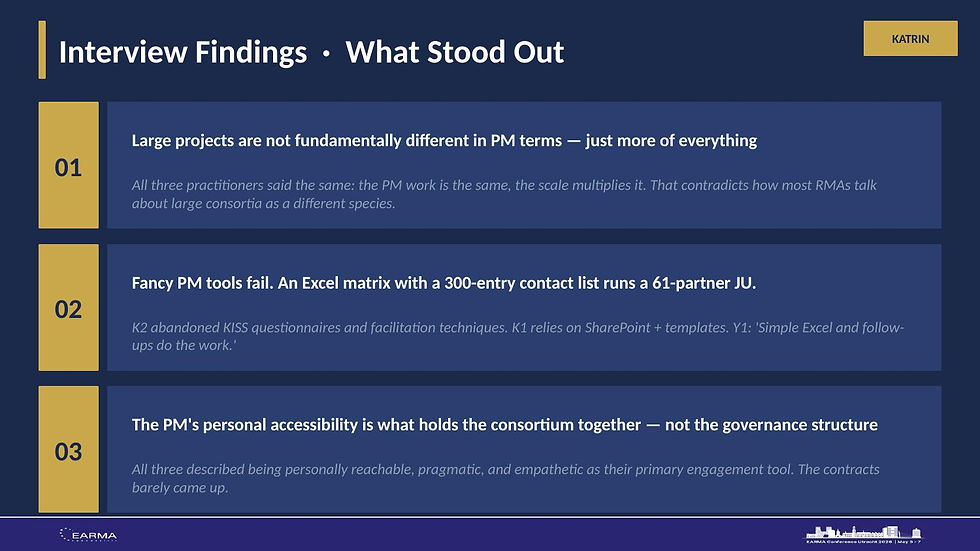
The most telling finding, though, was something we had to look at twice. All three practitioners, asked separately, said that managing a large consortium is not fundamentally different from managing a smaller one. The work is the same. The scale multiplies it. K1 made the point most directly: "the activities are the same — there are just more of them."
That is a sharper claim than it first appears. It contradicts a lot of how the research management community talks about large consortia — as if they were a different category of object, requiring different competencies. The practitioners who actually run them say the opposite. This has implications for training, career progression, and how RMAs prepare for stepping up to coordinator-level work.
What 80,000 Projects Show
The CORDIS analysis confirmed and complicated the practitioners' picture in roughly equal measure.
Budgets have grown, fast. The average project budget grew 91% from FP7 to Horizon Europe. This is not just inflation. The instrument mix has shifted toward larger collaborative projects, missions, and partnerships.
Consortia have grown, but more slowly than the headline suggests. The naive average consortium size grew 65% across the three Framework Programmes. But this masks a more interesting pattern. Among collaborative projects (those with two or more partners), the average grew from 10.1 in FP7 to 10.4 in H2020 to 10.9 in Horizon Europe — a steady but modest increase. The bigger shift is that single-beneficiary instruments (ERC, MSCA, EIC) have grown from 51% of all signed projects in FP7 to 63% in Horizon Europe. The population of EU-funded research has shifted toward solo grants, even as collaborative projects have themselves grown.
Duration scales with budget. Sub-€5M projects average 37.5 months. Cross the €10M threshold and the average jumps to 53 months — an extra year and a half. Larger budgets do not just bring more partners. They bring more reporting cycles, more personnel turnover, more accumulated risk, and more time for things to go wrong.
The most striking finding, though, is about concentration. Projects with 15 or more partners represent 9.6% of all signed grants in our dataset. Those same projects absorb 42.4% of total EU R&I budget across the three Framework Programmes. Large consortia are statistically rare. They are also financially dominant.

This concentration matters because it shapes where the management problem actually lives. The institutional infrastructure for large consortium management — dedicated project management work packages, professional research support offices, external PM consultants — exists because the funding model concentrates risk and complexity in a small slice of the portfolio. If you are a coordinator preparing a proposal for one of these calls, you are not joining a typical Horizon Europe project. You are joining the 1-in-10 cohort that absorbs 4-in-10 of the money.
Practical Lessons and a Mitigation Toolkit
The bridge from "what we observed" to "what to actually do" is where most research management writing gets vague. We tried not to.
A few things from the interviews are immediately actionable. Map every partner to tasks, contacts, and WPs on day one, and keep it live — Excel is enough. In-person kickoffs are mandatory, and at least one physical general assembly per year is non-negotiable — virtual-only consortia degrade. Onboard as if the partners know nothing: two to five structured emails in the first weeks save months of confusion later. For ghost partners, pick up the phone first — diagnose before intervening, and never start with blame.
Our own experience reinforced this. Front-load your effort. The first months are the most intensive and set the tone for everything that follows. Communication is a flywheel — it needs constant input to stay in motion, and re-starting it once it slows costs far more than maintaining it. Trust-based partner selection de-risks implementation more than any contract clause does.

The toolkit slide above was the one we asked the room to photograph. Most did. If you are running or supporting a large EU consortium, those four corners — day-one mapping, ghost partner protocol, communication architecture, engagement maintenance — are where we would put the marginal hour of effort.
What the Room Said
We ran three live polls during the session, deliberately structured so the audience answered each question before seeing what the data or the practitioners said. The numbers below are workshop-scale, indicative rather than statistical, but the patterns are interesting.
Poll 1 — What Makes a Project "Large"

Number of partners: 95%. Total budget: 49%. Everything else (countries, WPs, duration, ambition) was in single digits or the low teens. The funder framing leads with budget thresholds. The practitioners in the room told us, by a 2:1 margin, that the management burden lives in the partner count. Duration at 4% and country count at 6% are also worth noting. A 60-month project is not perceived as harder to manage than a 36-month one. The geographic spread is not what bites — it is who the partners are, not where they sit.
Poll 2 — Top Three Challenges in Managing a Large Consortium

Communication dominated, which is unsurprising. What is more interesting is the clustering. Around the central word Communication sit several closely related variants — Crosscultural communication, Time communication culture, Better constant communication, Set up meetings, Meetings. Around it: an engagement and commitment cluster (Partner commitment, Engagement, Non-responsive partners, Levels of engagement, Trust); a cultural cluster (Cultural differences, Different cultures, Culture, Personalities); a time and planning cluster (Finding time, Timeline, Timing, Deadlines, Planification); and a smaller conflict cluster.
This maps almost exactly onto what the practitioners told us in the interviews — but it had to be teased out from a noisy word cloud. The room arrived at the same diagnosis, in real time, that took three semi-structured interviews to draw out cleanly.
Poll C — One Thing You Will Do Differently Next Time
The closing poll was open-text, captured live as people typed. The full list is in the post-event PDF (below). The patterns are below, and they are sharp.
The dominant themes were: start earlier (Start earlier, Start early, Sit a plan with accuracy, Divide roles early, In-person meeting with coordinator at the start), better communication (More communication, Better constant communication, Communication is not a WP, it's all the project), and better tools and mapping (Create project matrix/database, A better mapping, Invest time in that Excel sheet, Budget more hours for PM).
The line that stayed with us was "Communication is not a WP, it's all the project." This anonymous comment, clearly typed in a hurry, echoed what Y1 told us in the interview — which the participant had no way of knowing. When the data, the practitioners, and the audience independently converge on the same point, it is probably worth taking seriously.
What We Take Away
The session set out to test whether large EU consortia are managed differently from small ones, or just more of them. The evidence — practitioner interviews, CORDIS data, AI consensus, and the audience itself — leans clearly toward the second. Large is more, not different. The PM work does not change in kind. The scale multiplies it, and the multiplication compounds: more partners means more communication, more cultural distance, more onboarding, more reporting touchpoints, and more accumulated friction.
That has practical implications. It means the competencies for managing a large consortium are continuous with those for managing a small one, not categorically separate. It means the answer to scale is not new methodologies or sophisticated tools but more disciplined application of simple ones — the Excel matrix, the structured onboarding, the in-person GA, the phone call before the email. It means budgeting communication time as a project-wide activity rather than a discrete WP. And it means recognizing, when preparing or reviewing a proposal for a large call, that you are entering the 9.6% of the portfolio that absorbs 42.4% of the money — and resourcing accordingly.
Our data, our interview themes, and the live tool that lets you query the CORDIS dataset are all available at orientos.com/cordis-db-analysis.
The full post-event deck is available as a PDF — right here:
Acknowledgement
We thank the European Association of Research Managers and Administrators (EARMA) for the opportunity to present this session, and the audience for showing up, voting, and engaging. We also want to apologize to those who could not enter. The room was full beyond capacity, with both seats and standing space taken. We hope this post and the deck go some way to making up for it.
__________________________________
Orientos is a Vilnius-based research management SME specializing in Horizon Europe consortium support, CD&E (communication, dissemination & exploitation), and EU grant management.
Katrin Reschwamm is Senior Research Manager at ETH Zurich; her travel to Utrecht was supported by an EARMA Mobility Grant.


Comments